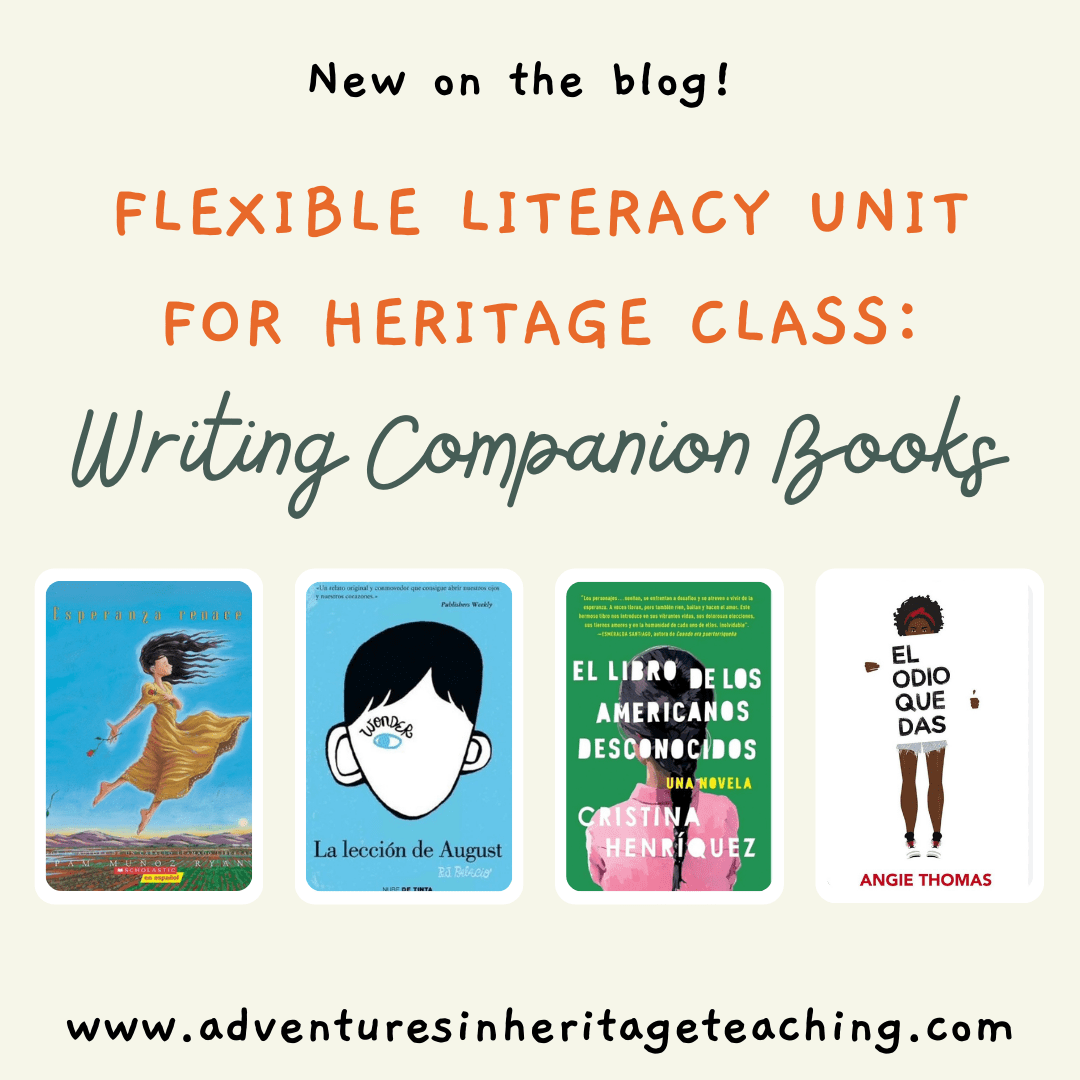
First of all, I’m so sorry it’s been such a long time since we posted a blog post about what’s happening in our heritage classes! I miss posting them, and I hope you miss reading them.
I am having a super joyful semester with my heritage classes this semester, and I wanted to share about one of my absolute favorite units to do with heritage classes. I love this unit because it incorporates both reading and writing, it can be done in SO many ways, and the students seem to really enjoy it! (I learned about this unit from Heinemann’s Writing Units of Study). For more information on our overall curriculum and how this unit fits in, see this blog post!
In this unit, students write a “companion book” (also called a “guide book”) about a novel. What is a companion book? You’ll probably recognize them from my examples, but you might have never heard that term (I hadn’t, either!). See below for some pictures of companion books. They are basically a book that is written about another book that helps readers understand that book (or movie, or videogame, etc.). There are various versions of them, some that are more text heavy, and some more graphic heavy.
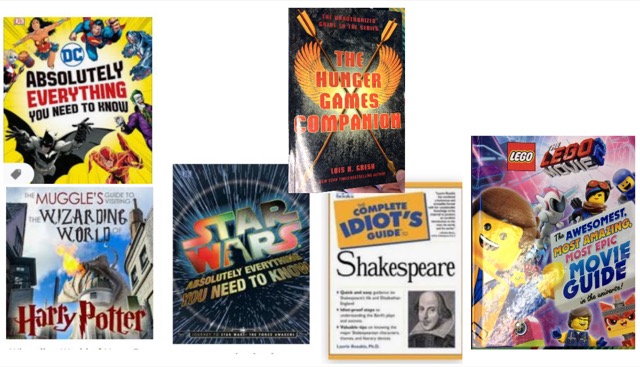
When we first start this unit, I ask the librarian to find several of them to check out to me so I can show them to my students. We pass them around, see what’s in them, what we like, what stands out, etc. I keep them in my classroom on a shelf for us to refer to for the whole unit. It was fun to expose my students to (or remind them of) this genre!
A note about levels: I have 11th grade heritage this semester, and this is a unit I’m doing with them. But I think what’s cool about this unit is you could do a version of it in pretty much any class!
Choosing what book to write the companion book about
I like to do this unit where each student is writing about their own book, but you could also do it where students write different chapters for a companion book about a shared class novel. If you did it about the same text, you could decide if students are in charge of writing just one chapter toward a class book, or if they each write their own. If they write more than a chapter, you could decide if one chapter is more graphic/visual and another chapter has to be text heavy, or one chapter is more basic information and one is more analysis or synthesis.
One of my favorite parts about this unit is that student buy-in was high, and one of the reasons for that was they got to work with their own books that they picked. For that reason, I don’t know if I’ll ever switch to doing a shared novel. One important step, if you’re going to allow them to do it about their individual book, is to double check ahead of time that they are reading a book that will lend itself well to this unit – I would recommend a novel (as opposed to a biography or something like that). I also let them choose to go back and reread a book they really enjoyed, or go to the library to see if they have a specific book they want to write about. It’s important to me that all students are currently reading the book during this unit, even if they are rereading it, so it’s fresh in their minds and so they can practice close reading and writing about specific quotes, etc. We read for 10-15 minutes at the beginning of class every day (if you want more info on that, see this blog post).
Developing their own ideas about the text
For the first several days of this unit, the students are writing to explore ideas about their book. It’s important to me that the chapters of their companion book include some synthesis of their own, not just summarizing the book or sharing basic information. But, of course, this is an area where you could adjust based on the level of the students you’re doing this work with; for lower level students, it might be appropriate to have some basic chapters (characters, plot, setting, conflict, etc.). For upper level students like mine, you can ask that either all or most of the chapters be about synthesis. And importantly, they don’t just have to come up with these new ideas out of thin air; I’m going to offer them several prompts over different days to help them start exploring ideas, and I’m going to demonstrate who I do that with a shared text.
Here are some prompts that we try those first 4-5 days to help them develop some of their own ideas:
- What caught your attention today when you were reading? Why? If it was a quote, copy the quote. Explain what you noticed and why, and why you think the author put it there.
- What is a confusing part about your book? What do you think would trip up a new reader?
- Could you create a visual (a chart, a map, a Venn diagram, a timeline, etc.) that would help make the thing that’s hard about your book, easier, for a new reader?
- How could you create a visual about your book to organize your thoughts about a character, a setting, an event, a cause and effect, a pressure map, etc?
- Can you write long to explain your thinking about the visual you created to someone who has never seen it before?
- What do you think is the theme/lesson in your text? (What is the lesson the main characters learn?) Where is the evidence of that lesson at the beginning, middle, and end of the unit?
- Does your writing contain both writing about details as well as big ideas like the evolution of characters and theme?
- How do the characters change throughout the course of the book (beginning, middle, end)?
- Does your writing about the book include academic vocabulary for writing about literature, like using words such as theme, symbolism, setting, dialogue, characters, etc.? If not, can you start including more of that vocabulary?
- What is the connection between characters, events, and setting? How do different characters react to different events and/or settings? How are events different because of where they take place?
And, obviously, I can’t just throw those prompts up there and ask them to go (even for 11th graders) – they need an example! Since my students were writing all about different books, I chose a short story that we read before the unit to use as a model. I would put up a prompt from that list, and show them how I started to think about that idea about the short story we’d read.
Planning the table of contents
After we wrote and explored ideas for several days, they picked their four best ideas to use as chapters for their guidebooks. I required that one chapter have a visual (they could just take a picture of their notebooks, as long as it was readable), and one chapter had to address the theme/message. They also had to decide which order to write the chapters in, and why.
Writing the guidebook
Then, we started writing. Basically, each chapter was kind of a mini essay. We wrote mini plans about what we wanted to put in each chapter (in my class, each chapter was multiple paragraphs, but again, in a lower level class, each chapter could just be a paragraph). I conferenced with them to check their plan, and then they wrote each chapter one by one, over a series of several days. At the end, we wrote an introduction and conclusion for the whole book. We did a self-assessment with the rubric and made a to-do list of final edits, and we also looked at several student examples, before turning in the final product. And let me tell you, the final products were outstanding!
Student examples of the phenomenal final product!
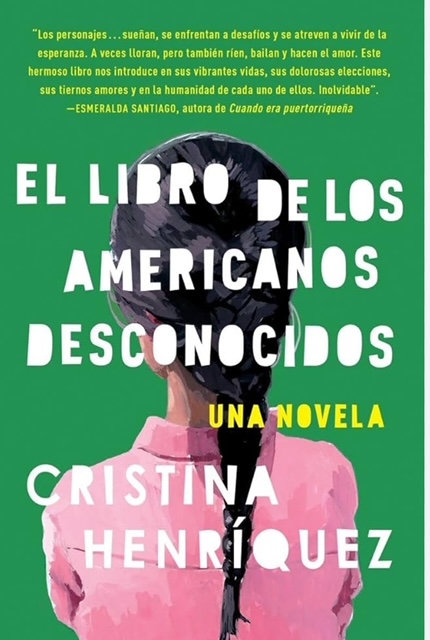
Student example 1 – Companion book about El Libro de los americanos desconocidos
Student example 2 – Companion book for Esperanza renace
Student example 3 – Companion book for Wonder: Las lecciones de August
Student example 4 – Companion book for El Odio que das
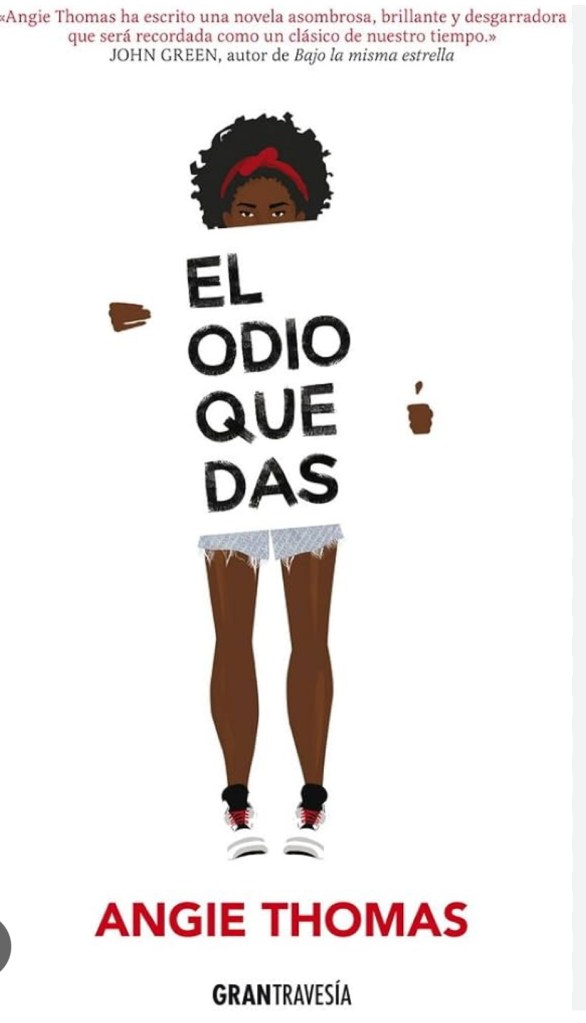
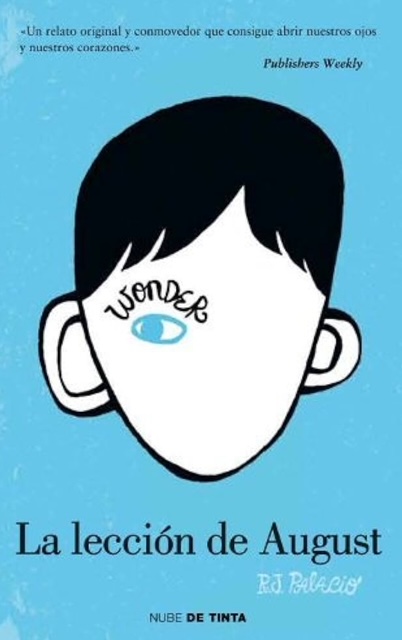
I was so very impressed with the level of work my students produced during this unit! I felt like they had a high level of ownership since they were writing about a book they enjoyed and wanted to read. (It was also a GREAT way to differentiate; the reading level of the books was different for every student). I loved that they were transferring what they knew about information writing to a new genre, and I was really impressed with the level of analysis in their writing. Overall, this was a really fun unit that combined reading and writing, and my students were super successful with their final products. They also absolutely rocked their test on information writing days after this unit. I highly recommend trying a unit like this, and if you try it, let me know how it goes!! I’d love to hear how it went!
Happy teaching, friends!
Adrienne
 Adventures in Heritage Teaching
Leave a comment